
THE FRAMEWORK
principle-based approach to decision-making under pressure
Reality Check teaches that decisions are guided by underlying truths that hold across situations, rather than fixed techniques or scripted responses.
It develops the ability to adapt, think, and act effectively when conditions are uncertain, dynamic, or unfamiliar.
It addresses the gap between training and real-world performance by focusing on adaptability, articulation, and the ability to function when conditions are uncertain, dynamic, and high-stakes.

A central component of Reality Check is the Trifective framework, which examines performance across three domains: the individual, the subject or situation, and the aftermath.
Each domain emphasizes perception, posture, and positioning, ensuring that decisions are effective in the moment and defensible afterward.

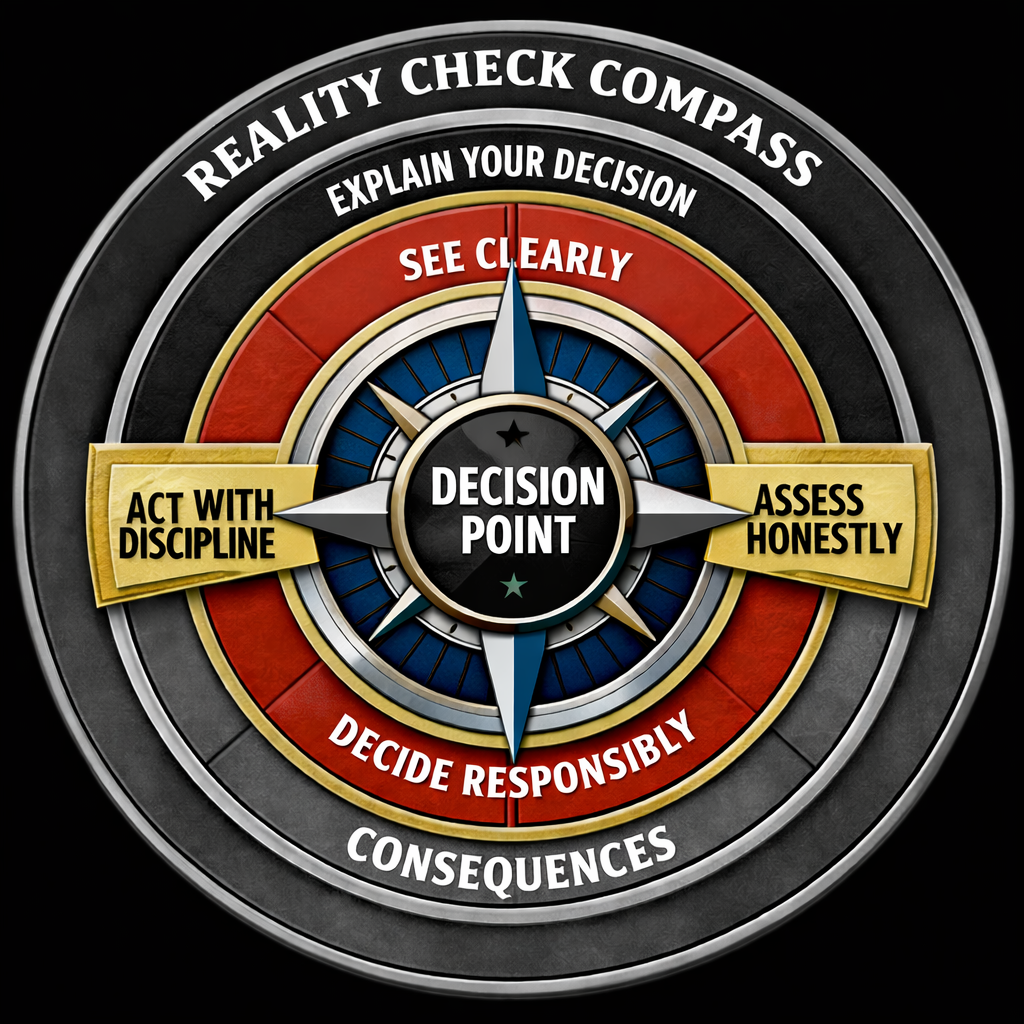
Rather than relying on scripted responses or ideal scenarios, Reality Check develops the capacity to think, communicate, and act based on what is happening in real time.
Pressure does not teach — It reveals.
Training must therefore build what remains under pressure, not just what works in practice.

Reality Check prioritizes outcomes over optics, focusing on what works under real conditions and what stands up to scrutiny. does not teach—it reveals.
Training must therefore build what remains under pressure, not just what works in practice.